

Yu Sleep Review: We Checked the Research Behind Every Ingredient (One of Them Doesn't Hold Up)

If you’ve spent any time at 2 a.m. staring at the ceiling, you already know the drill: melatonin gummies from the drugstore, a white noise app, maybe a weighted blanket that made things worse in summer. Most of it does something. Almost none of it comes with more than a marketing page as proof.
So before writing about Yu Sleep — a liquid sleep supplement built around ten ingredients — we did what we do before recommending anything: we pulled the actual peer-reviewed research behind each ingredient and checked whether it says what the marketing says it says. Two ingredients passed that check, melatonin more convincingly than L-theanine. One didn’t, and this review shows exactly why, with the same studies the product’s own marketing points to.
What’s Actually in It
Yu Sleep is a liquid blend of ten ingredients, taken as 2 mL (two droppers) per serving: melatonin, L-theanine, GABA, 5-HTP, vitamin B6, vitamin B2, magnesium glycinate, red tart cherry extract, apigenin, and lemon balm extract. Our ingredients guide lists all ten with the amount or ceiling for each. The maker says its “nano-enhanced” liquid format is absorbed faster than a capsule, though we haven’t found an independent study on this specific formulation’s absorption speed — that claim comes from the maker, not from a study we could verify.
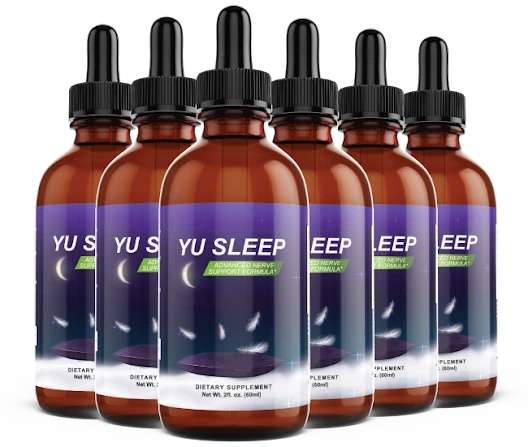
Two ingredients have real research behind them, though not equally strong. One doesn’t hold up as well as its marketing suggests.
Melatonin — genuinely well-studiedEvidence rating: Strong
A 2022 systematic review and meta-analysis — the highest tier of evidence in medical research, because it pools results across many trials instead of relying on one — looked at 23 randomized controlled trials and found melatonin supplementation had a statistically significant positive effect on sleep quality, measured by the Pittsburgh Sleep Quality Index, one of the most widely used sleep-quality scales in clinical research (Gholami et al., Journal of Neurology, 2022). Twenty-three trials, one consistent result: this is one of the better-supported natural sleep aids that exists. Yu Sleep uses a modest 0.9mg per serving, on the lower end of studied doses, which is generally associated with fewer next-day effects than higher doses.
L-theanine — modest evidence, some of it from a makerEvidence rating: Moderate
L-theanine, the amino acid found in tea leaves, is said to promote relaxation by increasing alpha brain wave activity, without acting as a sedative (Rao, Ozeki & Juneja, Journal of the American College of Nutrition, 2015). The same review reports a strong safety margin: no adverse effects were observed even at doses far above what’s used in a typical supplement. One caution about that source: all three authors are listed as working for Taiyo Kagaku Co. Ltd., a company that makes L-theanine. Independent pooled analyses since then are more modest: a 2025 meta-analysis found small improvements in self-reported sleep, and a 2026 meta-analysis found the evidence for less anxiety inconsistent. Our L-theanine guide goes through them.
GABA — the claim that doesn’t hold upEvidence rating: Limited
Here’s where we have to push back on how this ingredient is usually marketed, including on Yu Sleep’s own product page. GABA is the brain’s primary calming neurotransmitter, and it’s true that GABA in the brain is associated with relaxation. But taking GABA orally, as a supplement, is a different question — and when the same level of evidence is applied to it, it doesn’t hold up.
A 2020 systematic review — the same rigorous study design that made the melatonin case above credible — looked at 14 placebo-controlled human trials on oral GABA intake and concluded there is “limited evidence for stress and very limited evidence for sleep benefits” (Hepsomali et al., Frontiers in Neuroscience, 2020). Part of the issue is that GABA has long been thought unable to cross the blood-brain barrier when taken by mouth. The studies on that are contradictory, and the same review says no human data show whether it does, so it’s not clear how much of it reaches the parts of the brain where it would matter. We’re including it here because it’s in the formula and we don’t want to pretend it isn’t — but if you’re deciding whether to try this product, GABA isn’t a reason to weigh either way. Our GABA guide goes through the trials and who funded them.
The rest of the formula
Red tart cherry extract, 5-HTP, B6, B2, magnesium glycinate, apigenin, and lemon balm each have some supporting research for sleep-adjacent effects (mood, relaxation, circadian regulation) that we haven’t independently verified claim-by-claim for this article. If you want to dig into the primary sources yourself, Yu Sleep’s own product page lists its references, and we’d encourage checking them the same way we checked the three above — that’s a hygiene habit worth having for any supplement, not just this one.
Dose Transparency — What the Label Does and Doesn’t Say
The Supplement Facts panel shown on the maker’s website discloses exactly three doses per 2 mL serving: 0.5 mg of vitamin B2, 0.5 mg of vitamin B6, and 0.9 mg of melatonin. The other seven ingredients — red tart cherry juice concentrate, magnesium glycinate, apigenin, lemon balm extract, 5-HTP, L-theanine, and GABA — are grouped into a “proprietary blend” with one combined weight of 637 mg per serving. The label doesn’t say how much of each one is in it.
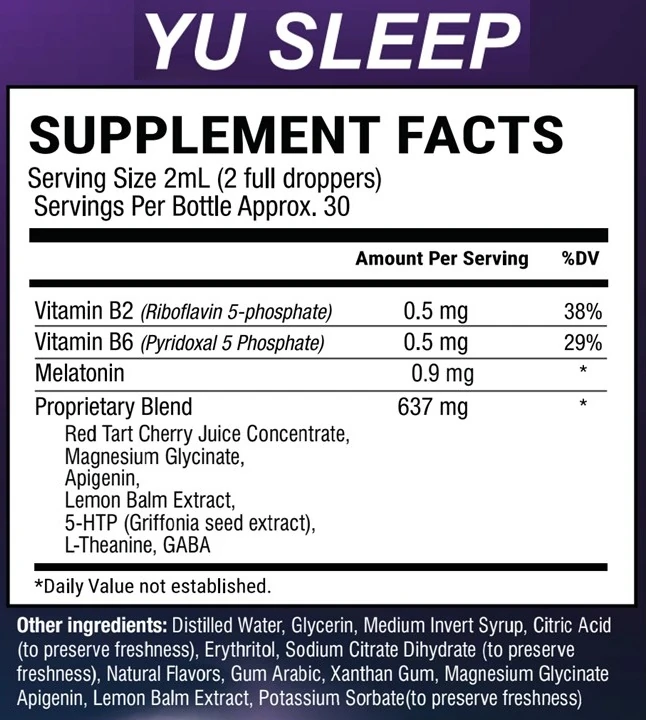
That matters because dose is what separates an ingredient that has been studied from an ingredient that is merely present. US labeling rules require the ingredients inside a proprietary blend to be listed in descending order of predominance by weight (21 CFR 101.36(c)(2); see also the FDA Dietary Supplement Labeling Guide, question 34). If this label follows that rule, its order (cherry, magnesium glycinate, apigenin, lemon balm, 5-HTP, L-theanine, GABA) puts hard ceilings on the last few. L-theanine, listed sixth of seven, can’t exceed about 106 mg per serving (637 mg ÷ 6), and GABA, listed last, can’t exceed about 91 mg (637 mg ÷ 7). For magnesium, even if the entire blend were magnesium glycinate — which it can’t be — it would supply roughly 90 mg of elemental magnesium, because that form is only about 14% magnesium by weight.
We’re not saying these amounts are too low. We can’t say that, and neither can anyone else, because the label doesn’t disclose them. What we can say is that you can’t line Yu Sleep’s amounts up against the amounts used in the studies linked in this article. Those studies report the doses they tested; check them yourself before you decide.
One more oddity: the “Other ingredients” line repeats magnesium glycinate, apigenin, and lemon balm extract, which are already listed in the blend. We couldn’t find an explanation for that, and it’s a fair question to put to the maker before you buy.
Safety Information
Here is what the maker’s page says about safety, and what the published sources we read add. We can’t tell you whether Yu Sleep is right for you. That is a question for a healthcare provider.
What the maker says. As of September 19, 2026, the text of the maker’s page carries only general disclaimers, which tell readers to seek a doctor’s advice before starting a supplement or before taking or stopping a medication. We found no warning specific to this product in that text: nothing on pregnancy or nursing, medications, allergies, side effects or drowsiness. We are working from the page and a picture of the label, so we can’t say what is printed on the bottle. Read the bottle before you use it.
Melatonin. The National Center for Complementary and Integrative Health says short-term melatonin use appears to be safe for most people, and that information on long-term safety is lacking. The mild side effects reported in short-term adult studies included headache, dizziness, nausea and sleepiness. It says people with epilepsy and people taking blood thinners should be under medical supervision if they take melatonin, and that there has been a lack of research on melatonin in pregnant or breastfeeding women. It also notes that some melatonin supplements may not contain what the label says (NCCIH, Melatonin: What You Need To Know).
5-HTP. 5-HTP is a precursor of serotonin. A 2020 review of its toxicology reports that it may cause dose-dependent gastrointestinal problems, with vomiting and nausea reported at doses above 100 mg, and that an excess of 5-HTP may lead to serotonin syndrome, a condition the review links to antidepressant medications (Maffei, International Journal of Molecular Sciences, 2020). The label doesn’t say how much 5-HTP is in a serving. If it follows the ordering rule described above, the amount is at most about 127 mg (637 mg ÷ 5) and could be much less. We can’t tell you whether that amount matters for you, and the label doesn’t let anyone work it out. If you take an antidepressant or any other medication that acts on serotonin, ask your prescriber before you add a 5-HTP product.
Who should ask a healthcare provider first. Anyone who takes medication, who is pregnant or breastfeeding, who has a medical condition such as epilepsy, or who is considering a supplement for a child.
What we did not check. We have not reviewed the safety of the other seven ingredients or of the finished formula, and this article cites no safety study of the product as a whole. Our Yu Sleep side effects guide goes through the ingredients one by one.
What This Product Is Not
It’s not a treatment for insomnia as a diagnosed condition, and it’s not going to fix a sleep problem that has a medical cause. If sleep issues are persistent, talk to a doctor before trying anything from a bottle. What Yu Sleep is, based on the ingredients that have research behind them, is a supplement built around melatonin and L-theanine, which have more research behind them than the rest of the formula, plus ingredients with more mixed evidence. The pooled research on both shows small average effects on sleep, and the American Academy of Sleep Medicine suggests clinicians not use melatonin for chronic insomnia (see our melatonin guide). We can’t tell you whether this product, at these amounts, does the same, and a PubMed search finds no study of the finished product. Our does it work guide weighs every marketed claim against the studies the sales page itself cites.
One more thing worth flagging: this is a supplement, not a medication, and it hasn’t been evaluated by the FDA for treating any condition — no legitimate sleep supplement has been, because that’s not how supplement regulation works in the US. Anyone claiming their product is “FDA-approved” for sleep is telling you something false; regulated facilities can be FDA-registered, which is a manufacturing-quality distinction, not a claim about the product working.
Price and Guarantee
Yu Sleep is sold in multi-month packages rather than single bottles, and the per-bottle price drops as the package gets bigger. As of September 18, 2026, the maker’s website lists:
| Package | Per bottle | Total |
|---|---|---|
| 2 months | $69 | $138 plus shipping |
| 3 months | $59 | $177 |
| 6 months | $49 | $294 |
A bottle holds about 30 servings, so that works out to roughly $1.65 to $2.30 per serving depending on the package. The page mentions free shipping with the 6-month package; shipping is listed as an extra on the 2-month one. Every package carries a 60-day money-back guarantee, and the page links to a separate refund policy that’s worth reading before you order.
One thing to watch for: the page also shows a “member discount” offer of $59 per bottle for your first two bottles, and then $49 per month. That’s a recurring subscription. The page says you can cancel with one click, but if you take it, you’re agreeing to be charged every month until you do, so check the cancellation terms at checkout before you enter payment details. Prices and offers change, so confirm them on the order page rather than relying on the numbers here. Our where to buy guide covers other retailers and how to check a listing sold by someone else before you order.
Bottom Line
If you’re looking for a sleep aid built on ingredients with real research behind at least part of the formula, rather than vague folk-tradition marketing, Yu Sleep contains two of the better-studied compounds: melatonin, at a clearly disclosed 0.9 mg, and L-theanine, at an amount the label doesn’t disclose. The research on both shows small average effects on sleep. The GABA isn’t a reason to buy it — that part of the pitch is weaker than it sounds. And because seven of its ten ingredients share one undisclosed-dose blend, we can’t tell you whether they’re present at anything like the amounts that were studied. If dose transparency matters to you, that’s a real limitation. Results vary by person and by what’s actually causing your sleep trouble in the first place; nothing here is a guarantee.
Sources cited in this article
- Gholami F, et al. “Effect of melatonin supplementation on sleep quality: a systematic review and meta-analysis of randomized controlled trials.” J Neurol. 2022. PMID 33417003
- Rao TP, Ozeki M, Juneja LR. “In Search of a Safe Natural Sleep Aid.” J Am Coll Nutr. 2015. PMID 25759004
- Hepsomali P, et al. “Effects of Oral Gamma-Aminobutyric Acid (GABA) Administration on Stress and Sleep in Humans: A Systematic Review.” Front Neurosci. 2020. PMID 33041752
- U.S. Food and Drug Administration. “Dietary Supplement Labeling Guide: Chapter IV. Nutrition Labeling,” and 21 CFR 101.36(c)(2). Read September 19, 2026. FDA guide
- National Center for Complementary and Integrative Health, NIH. “Melatonin: What You Need To Know.” Read September 19, 2026. NCCIH
- Maffei ME. “5-Hydroxytryptophan (5-HTP): Natural Occurrence, Analysis, Biosynthesis, Biotechnology, Physiology and Toxicology.” Int J Mol Sci. 2020. PMID 33375373
This article is for informational purposes and is not medical advice. Consult a healthcare provider about persistent sleep issues.
If this guide was useful, send it to someone who is also awake at 3 a.m.